






Introducing the HoneyBook MCP: ask Claude about your pipeline, invoices and contracts
Start a Trial
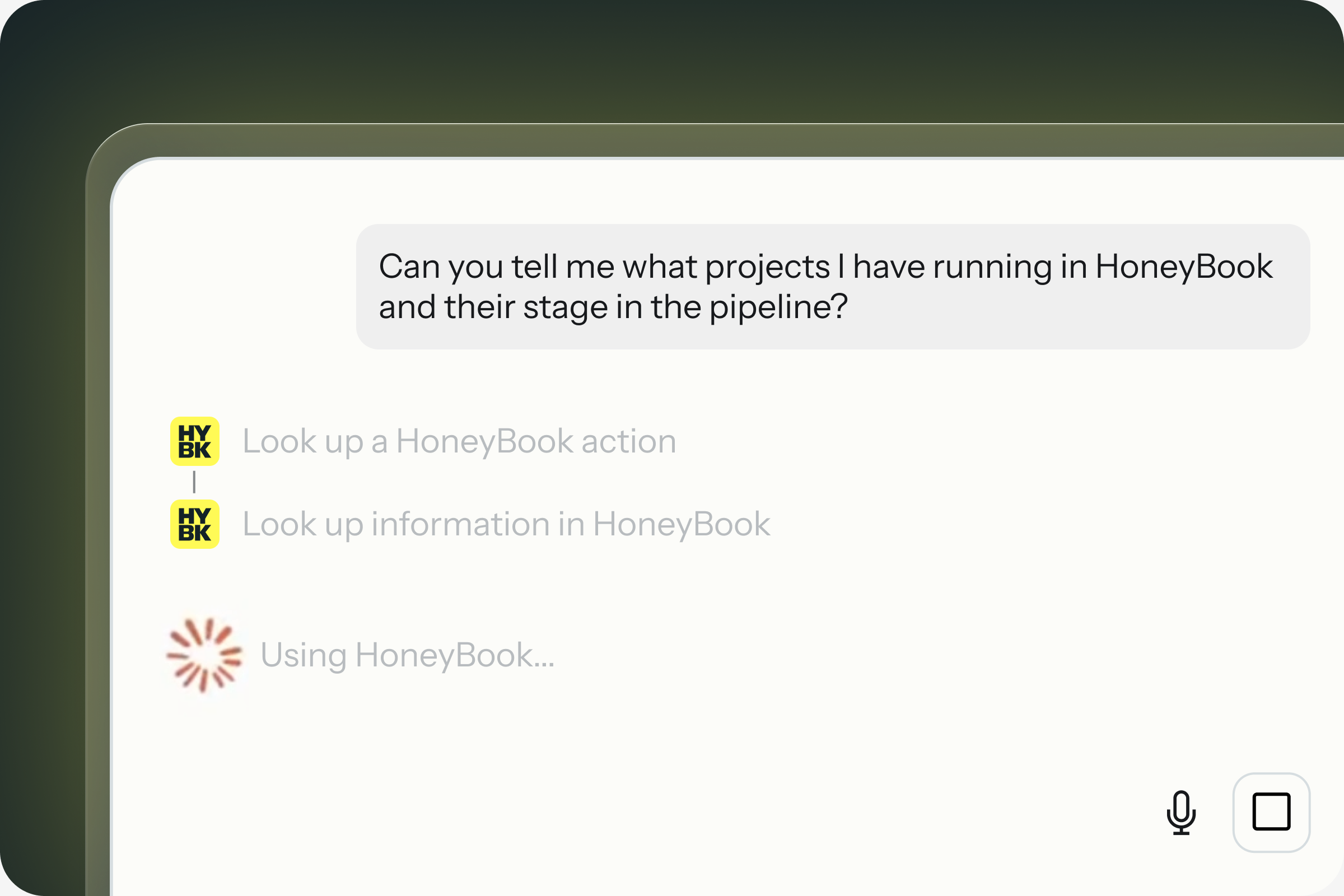
We are excited to announce the HoneyBook MCP: an open interface that lets AI agents work with a member's HoneyBook account, reading their pipeline, projects, invoices, contracts and client messages and, with the member's permission, acting on them. HoneyBook is simultaneously live as a verified connector in Claude's directory, the first place members can use it.
The whole client lifecycle, finally legible to an agent
For an independent business, HoneyBook holds the entire client lifecycle: the inquiry, the proposal, the signed contract, the payment schedule, the questionnaire, the thread of messages. It is the most complete record of how that business actually works, and until now, no AI assistant could see any of it. The HoneyBook MCP makes that record available to an agent as live data rather than an export, in one place.
And agents can act on it, not just read it
With the member's authorization, an agent can create and update projects and client records, attach notes and context where they belong, build a proposal, invoice or contract from the company's own templates, publish it for a client to open, and raise a standalone payment request. Permission is granted resource by resource, and nothing runs until the member grants it.
Where it gets genuinely useful: alongside everything else
A member's HoneyBook record rarely answers a question on its own. Combined with their accounting or payroll data, and with what the assistant already knows about how their industry works, it starts answering questions that no single tool could. Which booked work hasn't been invoiced. Whether a slow-paying client is the same one asking for more scope. What last quarter suggests about pricing the next job. The kind of question that used to mean four open tabs and an afternoon.
Why this matters for small businesses now
Independent businesses have been told for two years that AI would change how they work. In practice it mostly helped them write things, captions, emails, first drafts, because the tools could not reach the systems where the work actually lived. Connecting the system of record is what moves AI from drafting text to doing the job.
What early members did with it
Ahead of general availability, HoneyBook ran the connector with an early group of members across seven categories, including photographers, event planners, venues, DJs, business consultants, content studios and web designers. They used it mainly to reconcile their own records, finding delivered-but-unbilled work, stale leads and mislabeled clients. HoneyBook's own research points at the same pain: a recent company study found 97% of event venue managers struggle with disorganized booking systems, and a separate study named client booking management as the primary challenge for photographers.
"Giving our members a way to ask their own business a question and get the answer from what's actually in their account, not a guess - changes how the workday starts," said Helena Bachar, Senior Product Manager at HoneyBook. "The first thing people reached for wasn't drafting or writing. It was their own track record: what got delivered, what got billed, and what that tells them about the month ahead."
Built so the member stays in control
Because an agent acting on client and financial records demands more care than one reading them, permission is explicit and narrow. Members approve exactly which parts of their account an assistant can reach, resource by resource, before anything runs. Every request executes in an isolated environment that is destroyed when the request ends. Network access is restricted to HoneyBook, and the member's credentials are never exposed to the model.
Claude is the first place it works, not the only one
The HoneyBook MCP is built on the Model Context Protocol, an open standard. Claude is where HoneyBook is listed and verified today, but any MCP-compatible client can connect, including a member's own choice of assistant.
That openness is the larger point. The same interface that lets an assistant work in a member's account lets developers, agencies and technically-minded members build their own tools on HoneyBook: a custom dashboard, an internal workflow, an automation that spans HoneyBook and the rest of a business's stack. One venue-marketing agency working with HoneyBook members has already used it to extend its own service into the booking process. This is the first step in opening HoneyBook up as a platform.
What's next
The connector is designed to grow without members waiting on it. As HoneyBook's platform adds capability, that capability becomes reachable through the same interface, no new setup, no new integration. HoneyBook plans to keep widening what an agent can do on a member's behalf, and to keep expanding where the MCP can be used.
The HoneyBook MCP is available to HoneyBook members today, see here for set up instructions.

Helena is an Experienced Product Manager with a passion for innovative, data driven, SaaS based products. Highly skilled at bringing products and features to life, from ideation through execution and launch.