







10 real-world mission statement examples that can inspire your own
Start a Trial

When the idea for a new business strikes, you may want to launch right into marketing your products or services. But taking the time to first develop a mission statement can help you differentiate yourself, potentially contributing to your brand’s success.
The right mission statement acts as a compass for your decision making, inspiring your employees and customers with a shared vision. But a vague statement can fall flat with both groups and make your business direction seem aimless.
Find out what a mission statement is with examples from real brands alongside general tips.
What is a mission statement of a company?
A mission statement is a brief declaration that conveys an organization’s purpose and fundamental goals. It’s typically a short sentence or paragraph that explains the “why” behind a business, intended to inspire morale in employees and interest from potential customers.
Your mission statement is a unifying factor intended to inspire brand loyalty and set the tone for company culture. When you face difficult choices, a company mission ensures everyone acts in line with your core values.
You can use the statement to highlight your brand’s unique niche, setting you apart from competitors. By sharing your mission, you can highlight the work quality behind your products or services and chart a clear direction for your brand’s growth and success.

Stop starting from scratch every time.
Build reusable docs for every client stage and send polished, on-brand materials in seconds, not hours.
Explore templatesWhat makes a good mission statement?
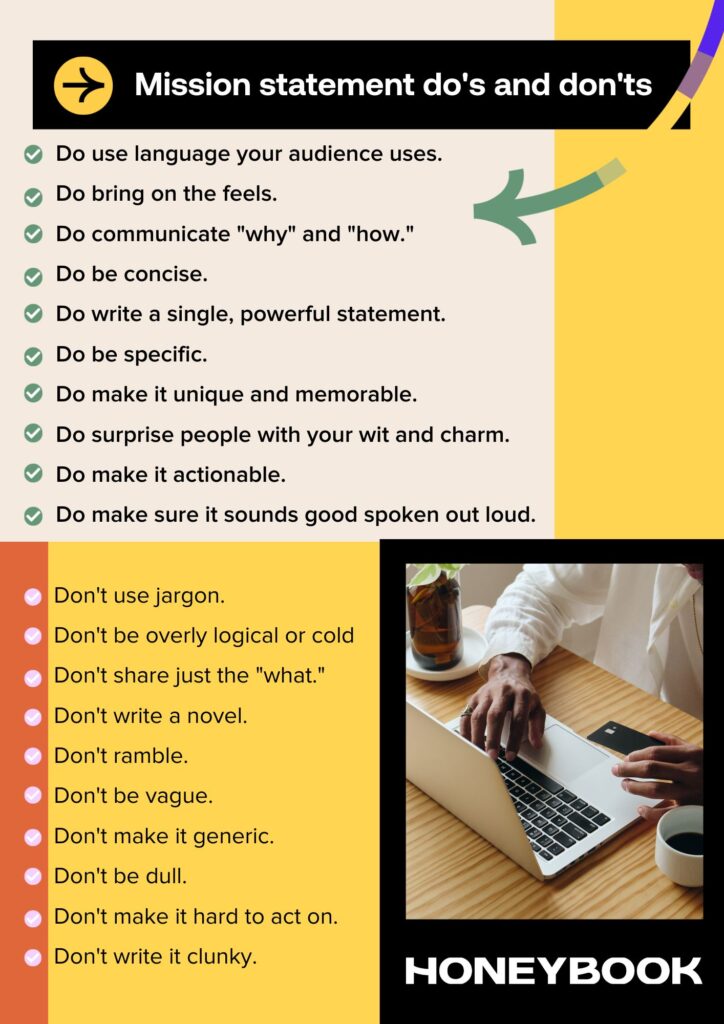
A mission statement can fall short if it fails to identify the business’s distinctive perspective. This makes the mission sound generic instead of showcasing an authentic identity and direction.
The best mission statement examples tend to share the following qualities:
- Clarity: It’s specific and unique.
- Emotional appeal: It strikes the right tone and inspires action.
- Core values: It aligns with your target audience’s values.
- Big-picture view: It addresses a larger purpose or impact.
For example, consider a brand's mission statement that lacks these elements:
“To be a leading provider of innovative solutions in the technology sector.”
This mission statement misses the mark because it isn’t unique; it could be true of any number of companies. The tone is also flat and doesn’t evoke emotion to spur employees to action. Finally, it doesn’t connect to core values or a larger purpose, like how these innovative solutions can help people.

Centralize your client management
Capture leads, sell services, manage projects, and nurture client relationships from one platform. All that and more with HoneyBook.
Get startedTop 10 small business mission statement examples
You can look to existing companies with the best mission statements to inspire you as you craft your own. Here are 10 mission statement examples from both independent businesses and larger companies.
1. Laura Lee Creative
Mission statement: “Helping purpose-driven entrepreneurs like you live up to your potential, bring your passions to life, and find freedom and success in a way that feels aligned to you.”
The mission statement of Laura Lee Creative strikes the right tone for its entrepreneurial audience:
- Clarity: It defines a unique business purpose up front (i.e., helping individuals achieve their professional passions on their own terms).
- Emotional appeal: It uses words like “purpose,” “passion,” and “freedom” to inspire.
- Core values: It’s directly aligned with entrepreneurial pain points and fits Laura Lee Creative’s value of work-life balance.
- Big-picture view: It defines business success beyond a bottom line, extending it to business owners’ sense of freedom and fulfillment.
2. Emilie Steinmann Creative
Mission statement: “For established businesses whose work depends on trust, taste, and transformation, I create refined brand identities and strategic websites that make your value easier to understand, trust, and act on.”
The mission statement from Emilie Steinmann Creative stands out for its specificity:
- Clarity: In two sentences, it articulates the value Emilie offers—helping established businesses achieve key goals (inspire client trust and action).
- Emotional appeal: Its focus on building trusted brands—not just providing copywriting or assets—showcases the depth of her commitment.
- Core values: The values of trust, strategy, and taste suggest Emilie holds her work to a high quality standard.
- Big-picture view: It connects day-to-day creative services to long-term business value.
3. The Systems Academy
Mission statement: “I believe software should feel effortless, systems should be invisible, and running a business shouldn’t cost you the life you built it for.”
Sydney Young’s mission statement has a compelling focus on simplicity:
- Clarity: It states that business systems should be effortless, not overwhelming, to set up.
- Emotional appeal: It motivates entrepreneurs with a can-do tone and focus on work-life balance.
- Core values: It speaks to entrepreneurial values of adaptability and holistic success.
- Big-picture view: It suggests business owners can use tangible strategies to simplify their work and personal lives.
4. The Contract Shop
Mission statement: “Our company mission is to give every small business owner the tools that they need to confidently manage their business, since everyone should have the opportunity to pursue their passions without legal problems getting in the way.”
The mission statement of Christina Scalera makes an impression by focusing on small business owners:
- Clarity: It connects legal protections with the ability to successfully manage a business.
- Emotional appeal: It acknowledges that legal issues can create headaches.
- Core values: It speaks to entrepreneurs seeking legal support who want to feel confident.
- Big-picture view: It sets up legal protection as a foundational necessity, instead of simply a checklist item.
5. Candice Coppola
Mission statement: “I’m on a mission to help women discover their gifts, build businesses around their talents, and live each day on purpose.”
This mission statement from Candice Coppola is concise but still has emotional appeal:
- Clarity: It focuses on inspiring female entrepreneurs to live and work with intentionality.
- Emotional appeal: It emphasizes meaning for entrepreneurs looking for ways to sustain their passions.
- Core values: It reflects common values held by business owners, including purpose, optimism, and personal fulfillment.
- Big-picture view: It highlights Candice’s approach to entrepreneurship, valuing more than financial business success.
6. Nike
Mission statement: “Bring inspiration and innovation to every athlete in the world.* *If you have a body, you are an athlete.”
Nike’s mission statement showcases its distinct personality and inclusive values:
- Clarity: It specifically states that the company aims to innovate and inspire athletes.
- Emotional appeal: It uses a playful asterisk to emphasize that everybody is an athlete and thus part of Nike’s target demo.
- Core values: Nike’s statement underlines innovation, inclusivity, and performance excellence.
- Big-picture view: Its definition of athleticism goes beyond tradition, to motivate all people to strive for greatness.
7. Google
Mission statement: “Organize the world’s information and make it universally accessible and useful.”
Google promises universal benefits from innovation with its ambitious mission statement:
- Clarity: It specifies that Google’s main function is to organize and distribute information.
- Emotional appeal: It evokes a future for the internet that’s open to everybody and beneficial to society.
- Core values: It centers Google’s values of innovation, accessibility, and usefulness.
- Big-picture view: It stands out from other technology companies by committing to making information accessible, not just organizing it.
8. Starbucks
Mission statement: “To be the premier purveyor of the finest coffee in the world, inspiring and nurturing the human spirit—one person, one cup, and one neighborhood at a time.”
With its mission statement, Starbucks offers a heartfelt vision of connection:
- Clarity: It connects the coffee shop to the nurturing of the human spirit, evoking community.
- Emotional appeal: “One person, one cup, and one neighborhood” uses repetition for emphasis.
- Core values: It promotes core values like generating positive social impact and fostering a sense of community.
- Big-picture view: It goes beyond other coffee chains by focusing on creating meaningful connections and making a difference in people’s everyday lives.
9. Amazon
Mission statement: “To make customers’ lives better and easier every day by relentlessly inventing on their behalf.”
This well-known mission statement centers Amazon’s customers as the company’s top priority:
- Clarity: With one brief sentence, this mission puts the needs and satisfaction of Amazon’s customers above all else.
- Emotional appeal: It tells customers that Amazon gears its decisions toward enhancing satisfaction.
- Core values: The mission reveals Amazon’s obsession with the customer through values like innovation.
- Big-picture view: It inspires employees to be the best in the world by making good on the promise to achieve top customer experience.
10. Microsoft
Mission statement: “Microsoft’s mission is to empower every person and every organization on the planet to achieve more.”
Microsoft conveys an inspiring, action-oriented mindset:
- Clarity: It’s focused on maximizing productivity for individuals and organizations everywhere.
- Emotional appeal: Its ambitious tone suggests that anything’s possible and that productivity and success are attainable.
- Core values: It elevates Microsoft’s values of empowerment and inclusivity, suggesting its products benefit society as a whole.
- Big-picture view: It takes organizational success to a new level by suggesting its products can unlock greater achievement and global productivity.
Drive your business forward with HoneyBook
Now it’s your turn. Use HoneyBook’s mission statement examples and actionable tips to craft your own. You can even use a mission statement generator to come up with a solid starting point.
Writing a memorable mission statement is just one part of making your business stand out. You also need the right tools to remain organized and foster strong client relationships. On HoneyBook, you can drive your business forward by managing inquiries, bookings, communications, and payments all in one place.
Start your free trial today.

Create your free mission statement
Now it's your turn! Make a statement that represents your brand values. Just plug in your business information and get a new mission statement in minutes.
Try it for free
I'm a HoneyBooker—writing about small businesses, the people who run them, and tips and tricks to help them grow. I also run Quiet Like Horses, helping small business owners become better writers. So you can use your words to grow your business—and make more money.