






Choosing the best CRM for a one-person business
Start a Trial

Running a business solo comes with unique challenges. Being in charge is rewarding, but when work ramps up, there’s no one to pass tasks to. The right customer relationship management (CRM) platform can lighten the load by keeping your contacts, leads, client information, and follow-ups organized.
While many CRMs cater to large organizations, some are built specifically for small businesses or solo operators. This guide highlights some of the best CRMs for one-person businesses to help you find the right tool for your workflow.
Key benefits of having a CRM as a one-person business
When every responsibility—from closing deals and managing finances to providing great customer service—lands on a single desk, staying organized becomes essential. A CRM creates structure, reduces manual work, and keeps important details from slipping through the cracks.
Some key benefits include:
- Centralized contact management: Keep every lead, client, and partner detail in one place so you never misplace contact information.
- Improved workflow organization: Create to-do lists for each project type so you always know what needs attention and when.
- Time-saving automation: Let the CRM handle repetitive tasks, like scheduling meetings or sending invoices, while you focus on client work that drives revenue.
- Better client follow-ups: Track each client as they move through the sales pipeline and use automated follow-ups to stay responsive without extra effort.
- Increased efficiency: With all your operations consolidated in one platform, you spend less time switching between tools and more time serving clients.

Manage every part of your client relationships
Capture leads, convert, and provide an excellent experience with HoneyBook. Go beyond a standard CRM.
Get startedTop CRM alternatives compared at a glance
Here’s a quick overview of the leading CRMs for solo business owners.
HoneyBook
HoneyBook is an all-in-one client management platform that combines CRM capabilities with essential small business tools like scheduling, proposals, contracts, and invoicing. It’s built for independent professionals—including event planners, virtual assistants, artists, coaches, and consultants—who need one intuitive platform to manage their entire workflow.
Key features
- CRM with built-in lead capture forms
- Library of professional templates for proposals, contracts, onboarding, and invoices
- Automated meeting scheduling
- Integrated payments and finance tools
- Branded client portals
- Customizable automations
Keep every client relationship organized.
Track leads, manage projects, and follow up at the right time, all from one place built for your business.
Try HoneyBook CRMPros and cons of HoneyBook
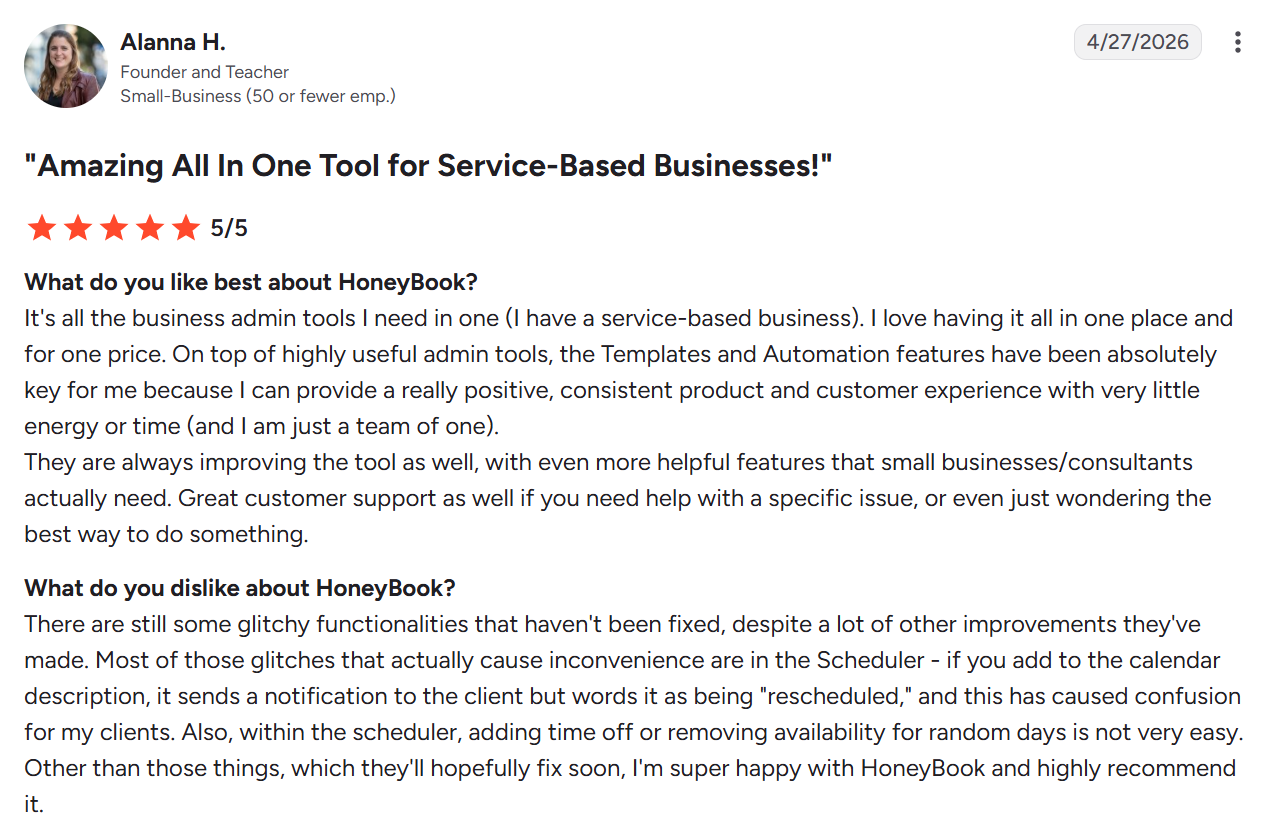
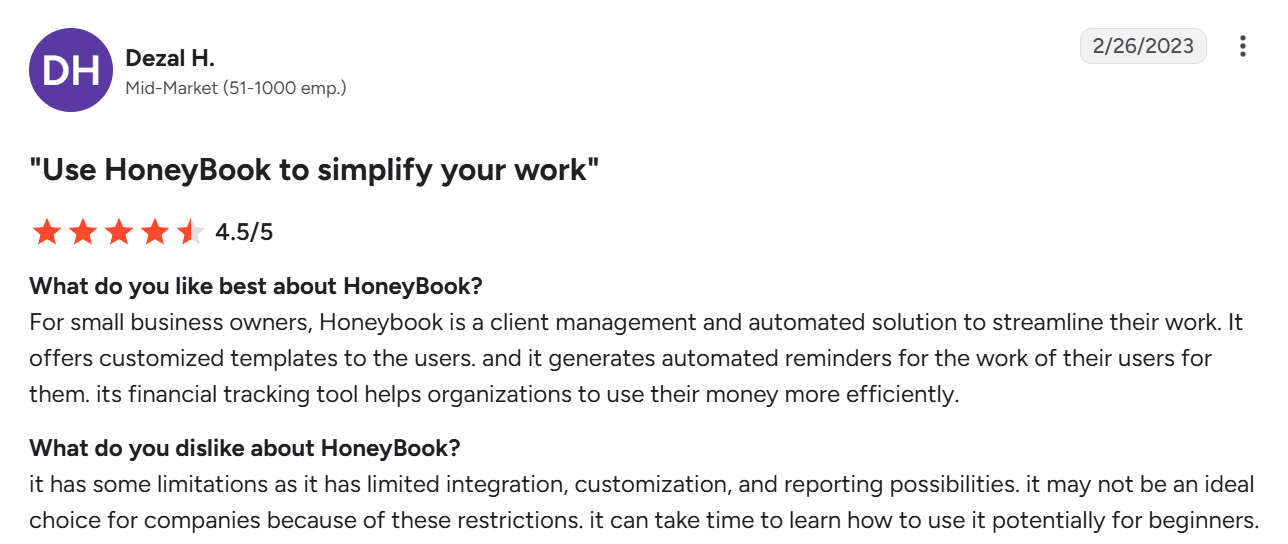
HoneyBook users love the platform’s user-friendly interface and quick setup process. This easy-to-use CRM for small businesses also helps you create a professional client experience with branded documents and lead forms.
However, HoneyBook may not be the right fit for business owners who rely heavily on a mobile device. While HoneyBook’s mobile app is helpful, it doesn’t offer the full functionality of the desktop version. Its reporting features are also not as extensive as larger, enterprise CRMs.
HoneyBook reviews
OnePageCRM
OnePageCRM is a lightweight CRM designed for small business owners who want a way to manage their sales pipeline without complex onboarding or heavy integrations. The entire platform is task-focused, with to-do lists to help you stay organized during a busy workday.
Key features
- Unlimited contact management
- Automated lead capture from social media or email
- Deal tracking with follow-up reminders
- Drag-and-drop web form builder
- Automated email sequences
Pros and cons of OnePageCRM
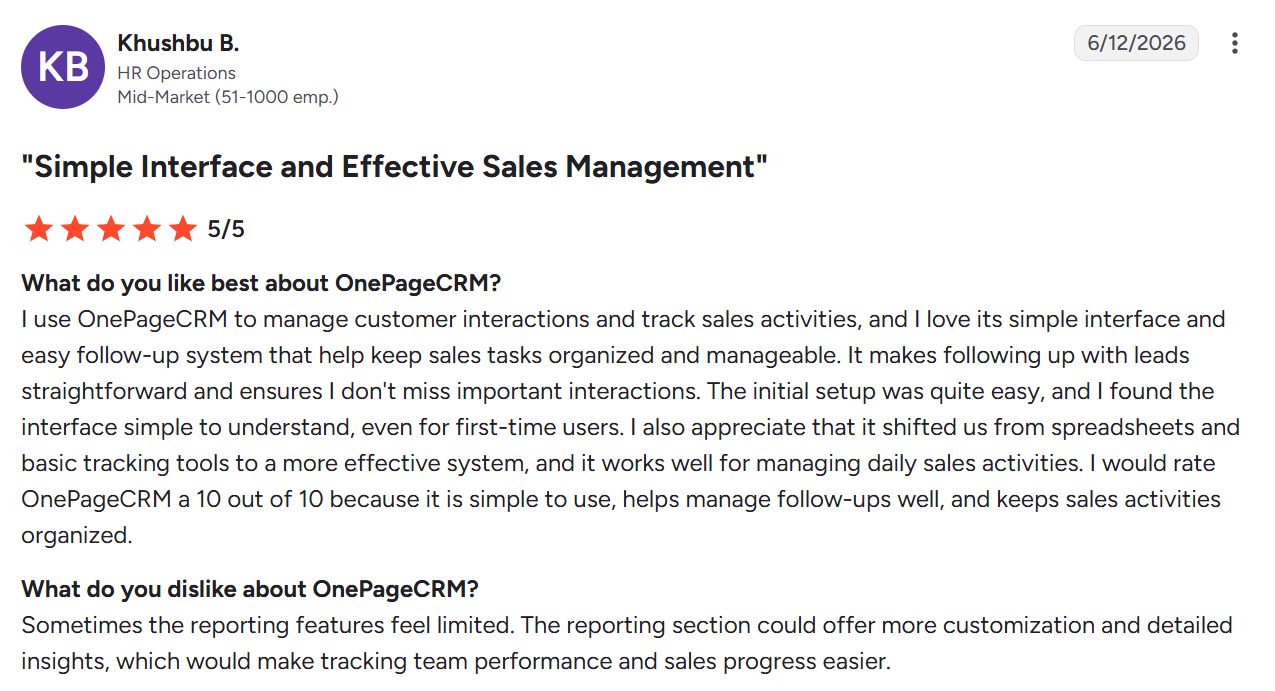
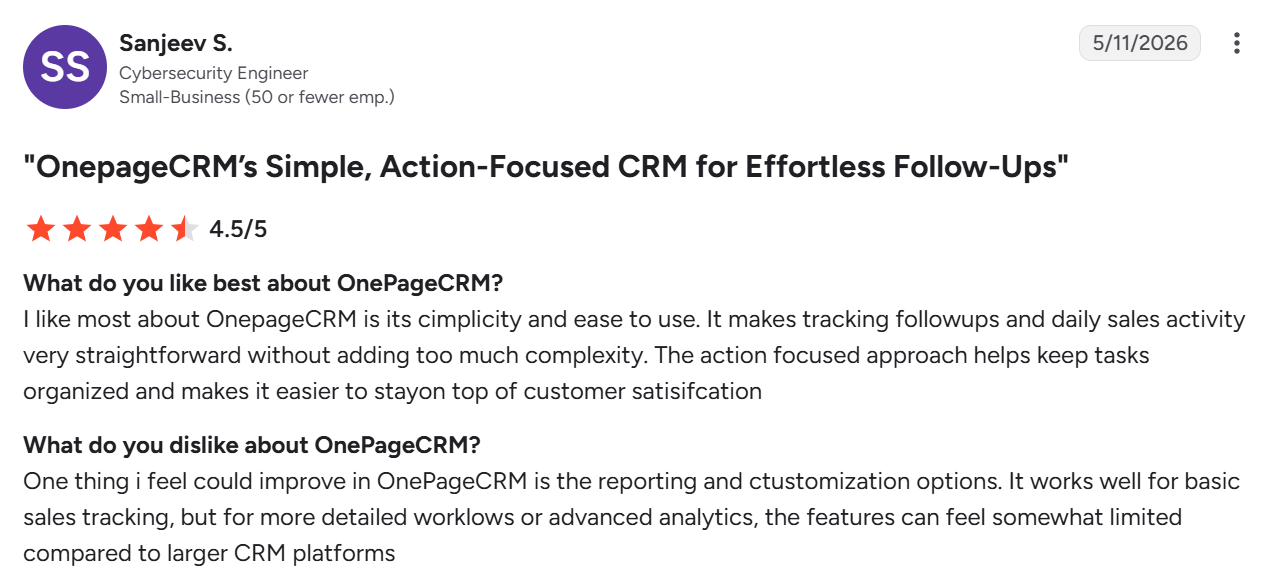
Users appreciate OnePageCRM’s simplicity and minimal setup. It’s a good alternative to spreadsheet-based lead tracking, offering a clean interface that doesn’t require advanced technical knowledge. The platform’s focus on task prioritization and follow-up reminders also helps small business owners stay organized and move deals forward.
On the downside, OnePageCRM lacks broader business tools, such as invoicing and contracts. Its reporting capabilities are limited, and customization options are minimal, which can make the platform less scalable for fast-growing one-person businesses.
OnePageCRM reviews
Less Annoying CRM
Less Annoying CRM is a basic CRM for small businesses designed as an alternative to enterprise CRMs that feel bloated. Its simple, modern interface and flexible features make it easy to adapt to different types of workflows without overwhelming solo business owners.
Key features
- Unlimited contact tracking with activity logs
- Customizable sales pipeline tracking with follow-up reminders
- Activity reporting and daily agendas
- Lead form builder
Pros and cons of Less Annoying CRM
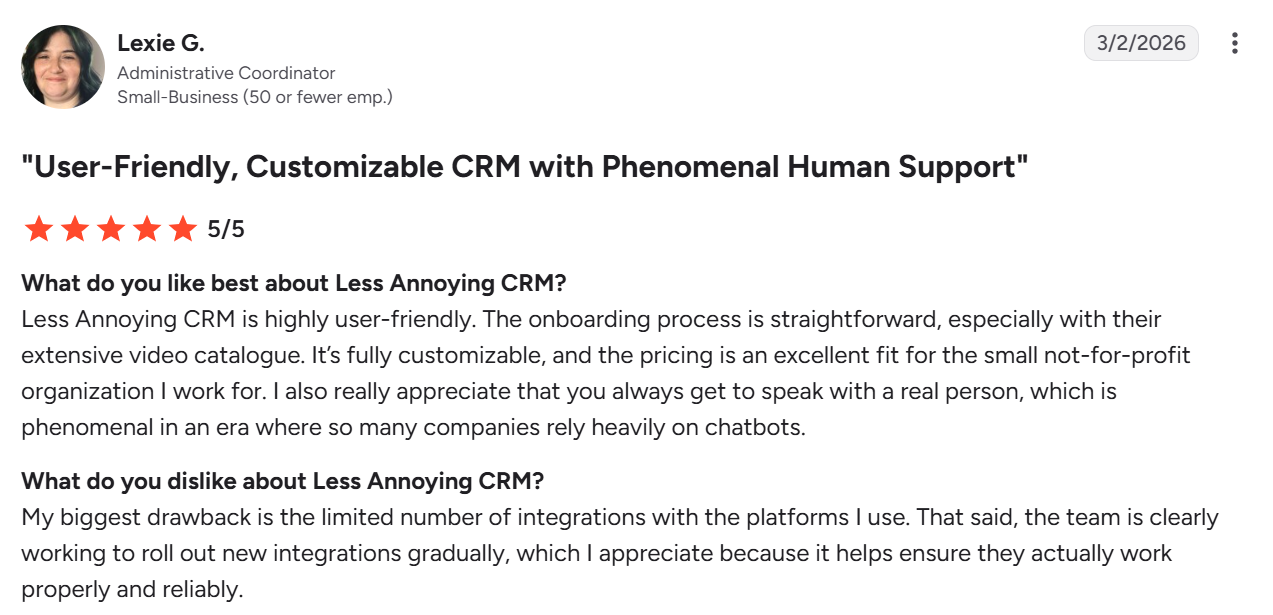
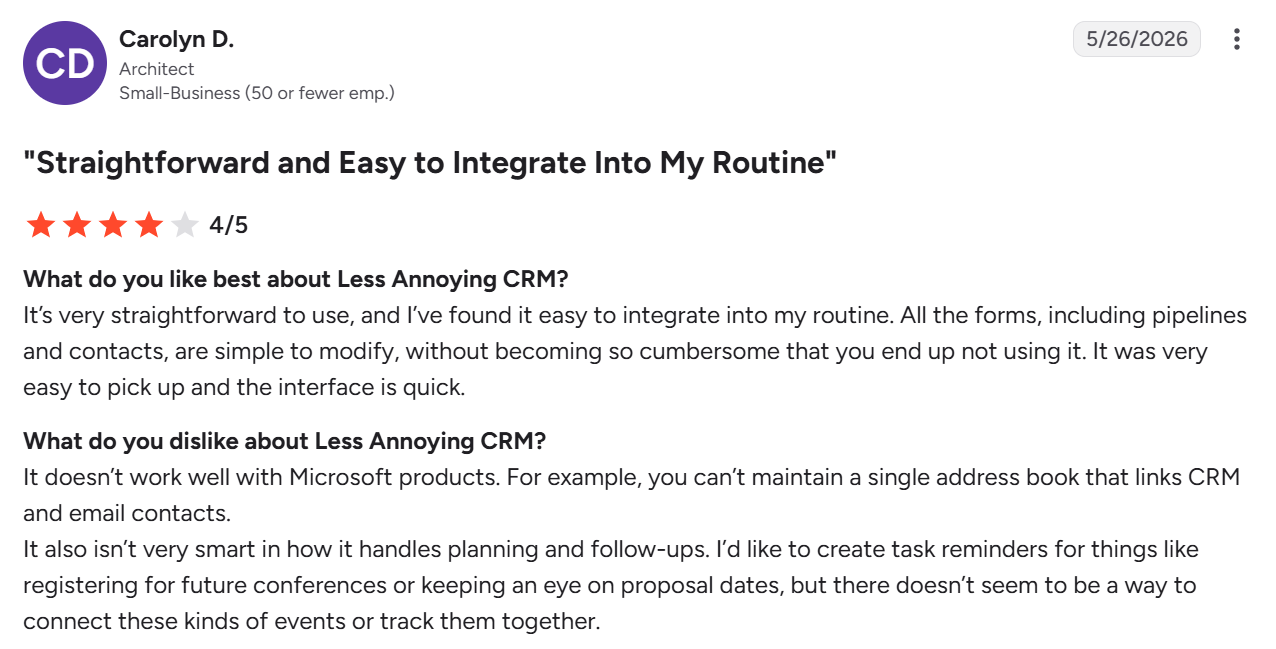
Users like Less Annoying CRM’s user-friendly interface. It’s easy to add new leads, manage follow-ups, and customize pipeline stages, even if you’re not tech-savvy. The platform’s simplicity is a major draw for small business owners who want structure without complexity.
However, some users note that Less Annoying CRM has limited integration options, which may make scaling more difficult. It also lacks built-in tools for contracts or invoices, so business owners need to use multiple tools to handle the entire client lifecycle.
Less Annoying reviews
Bigin by Zoho CRM
Zoho offers a broad suite of business management tools, including multiple CRMs as well as tools for marketing, finance, HR, and customer service. Bigin is Zoho’s small business CRM designed to deliver many of the same features as Zoho CRM without the complexity. It’s a good choice if you already use other Zoho products and prefer native integrations.
Key features
- Pipeline and task tracking
- Mass email campaigns
- Integrated phone calls
- Online booking pages
- Digital payment collection
- AI support
Pros and cons of Bigin
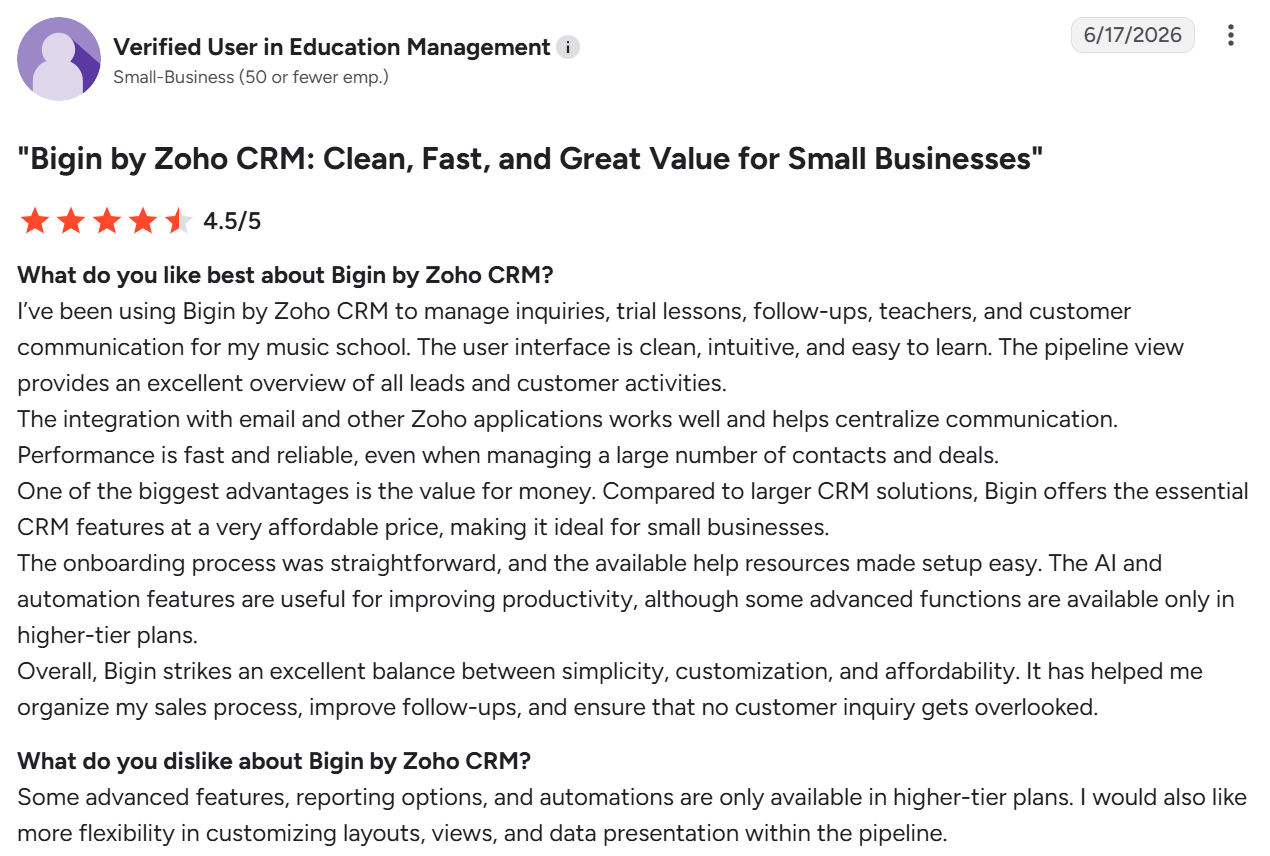
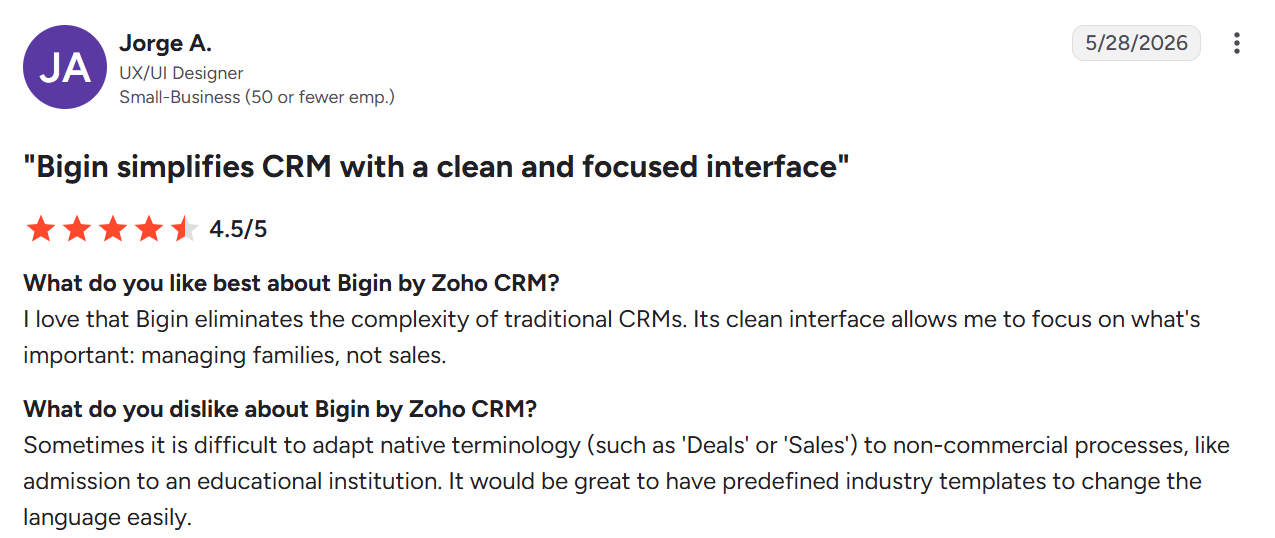
Bigin users appreciate that the platform provides a simpler and more affordable alternative to enterprise CRMs. Its user-friendly interface, pipeline customization, and automation options make it easy to adapt the dashboard to your workflows. The platform also offers basic payment and marketing automation features that are helpful for solo business owners.
Its drawbacks include complex automation setup and limited customization on the free tier, which can constrain solo business owners on a budget.
Bigin reviews
Pipedrive
Pipedrive is a CRM tool that helps solo business owners keep track of leads and visualize their sales pipeline. Its AI features provide insights about new opportunities and can generate outreach emails to keep momentum going.
Key features
- Lead tracking and pipeline visualization
- Lead forms and website chatbots
- Lead scoring
- Project management tools
- Email marketing automation
- Automations and AI assistant
Pros and cons of Pipedrive
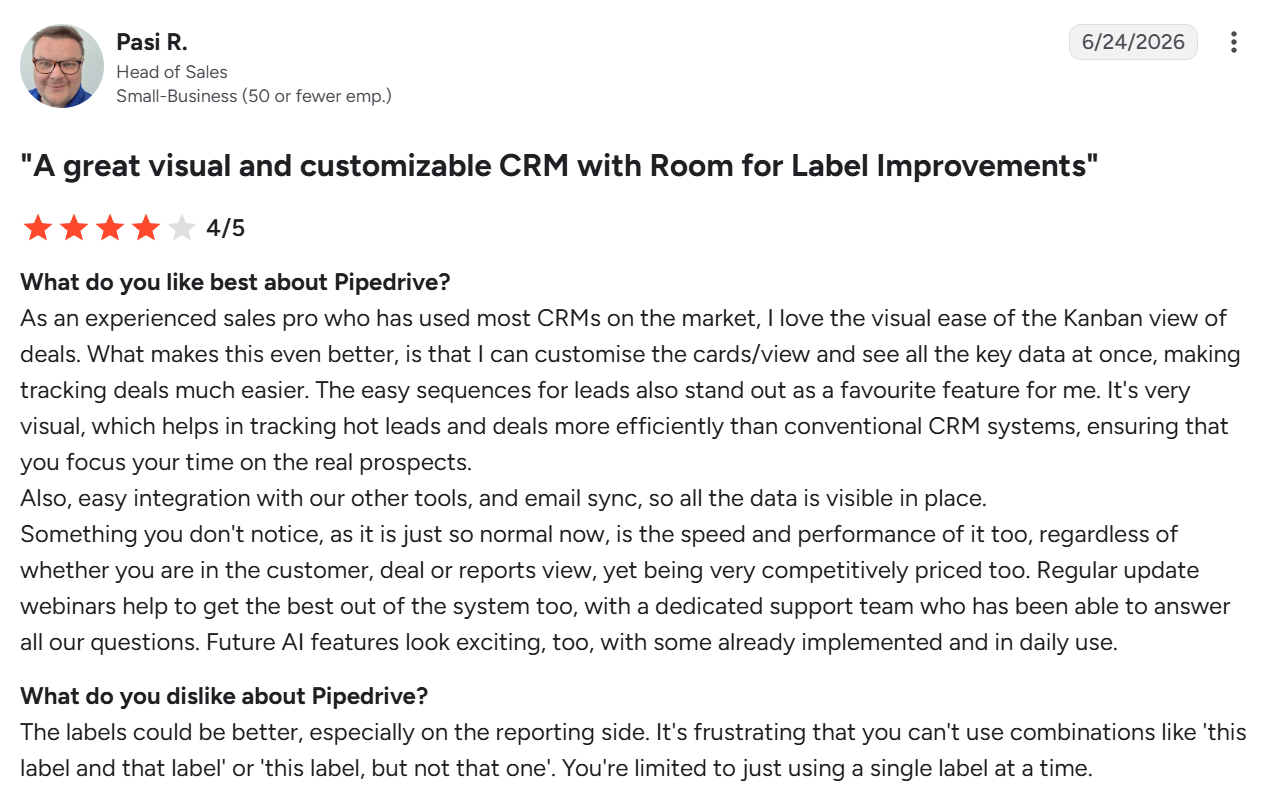
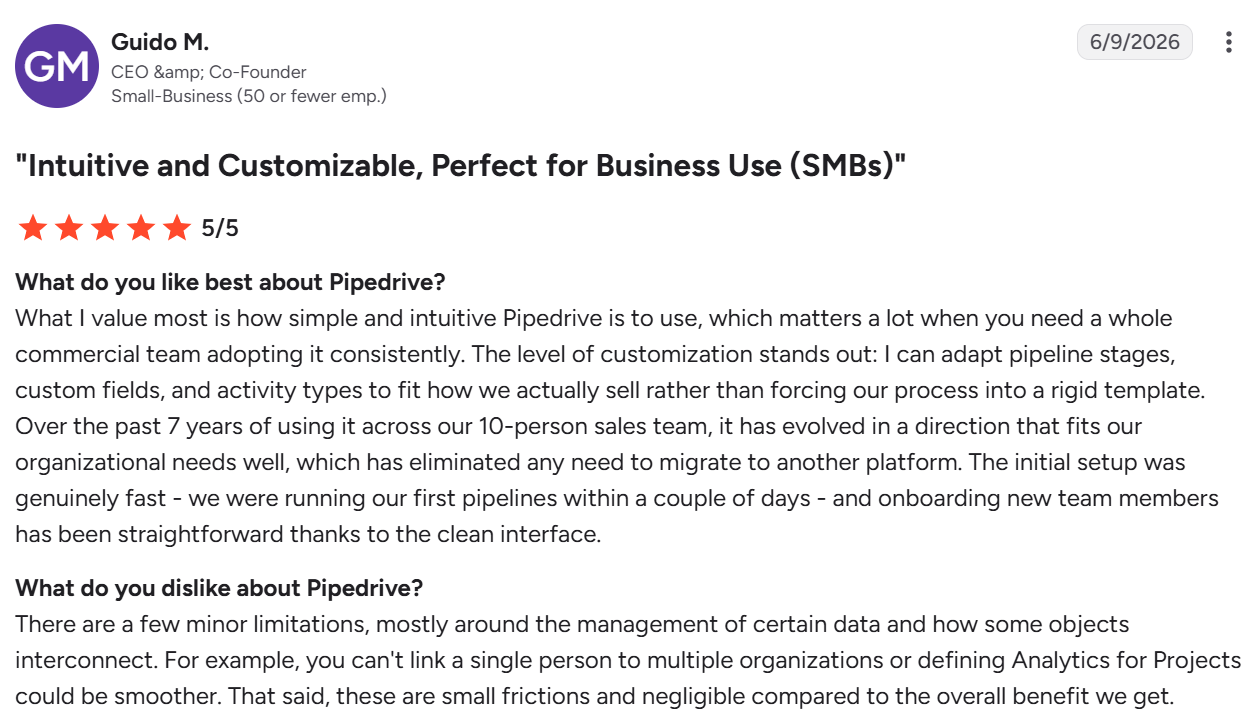
Pipedrive users like the platform’s clean, visually appealing interface and easy drag-and-drop pipeline customization. The platform scales well as you take on more clients, and its wide range of integrations makes it flexible for different workflows.
On the downside, some users note that Pipedrive’s reporting options are limited and can feel restrictive. The platform also lacks built-in features for proposals, contracts, or invoices, so business owners will need to rely on other tools to manage those parts of their workflow.
Pipedrive reviews
What to look for when choosing a CRM for your business
Not every CRM is a good fit for a one-person business.
As a solo business owner, you need client management software that simplifies—not complicates—your workflow. And larger CRMs with steep learning curves, like HubSpot or Zoho CRM, can feel overwhelming.
Here’s what to look for in a CRM for a one-person business:
- Ease of use: An intuitive interface allows you to get started quickly without a lengthy onboarding process.
- Workflow automation: Automation and AI tools reduce manual work and save time on busy days.
- Customization: Flexible settings let you tailor the CRM to your workflows and scale it as your client base grows.
- Integration options: The CRM should connect easily with the rest of your tech stack.
- Mobile accessibility: Many solo business owners work on the go, so look for a CRM app that’s accessible on mobile.
- Reporting and analytics: Reporting tools provide helpful insights into how your business is performing.
- Security and data protection: Strong data protection policies safeguard the sensitive client information stored in the CRM.
- Pricing: The platform should fit your budget without compromising on key features. Look for platforms with a free trial so you can evaluate its capabilities before committing.
HoneyBook simplifies client engagement for solo businesses
Solo business owners need CRM software that saves time and reduces stress.
HoneyBook combines CRM functionality with proposals, contracts, scheduling, invoices, and payments so you can manage the entire client journey in one place. Its customizable automations take care of follow-ups and other routine tasks, freeing you to focus on growing your business.
Start a free trial today to see whether HoneyBook is the right fit for your business.
Centralize your client management
Capture leads, sell services, manage projects, and nurture client relationships from one platform. All that and more with HoneyBook.
Get startedFAQs
Can HoneyBook help automate client management and workflows?
Yes. HoneyBook includes customizable automations that handle repetitive tasks like scheduling, follow-ups, and invoicing, reducing the amount of manual work on your plate.
How does a CRM help a one-person business stay organized?
A CRM keeps contact information and project details in one convenient place. Many small business CRMs also offer task tracking and automations that help solo business owners work more efficiently.
How does HoneyBook support invoicing, contracts, and scheduling in one platform?
With HoneyBook, you can manage the entire client workflow in one integrated platform. After a lead form is submitted, clients can book meetings through HoneyBook’s built-in calendar. You can then create proposals and contracts using its template library, and send branded invoices with digital payment options when it’s time to collect payment.